
By Lucas Abal.
«One day, I’ll drop everything and open a bar on the beach.» These words have become more of a cliché than a genuine expression of intent. You’ve probably thought or even said it yourself at some point, but the idea never felt serious for more than a moment. And if you did entertain it briefly, the practical questions—Where? How viable would it be?—likely made you abandon the thought just as quickly as it came to your mind.
However, a few years ago, famed bartender Tato Giovannoni made this fantasy a reality, and La Nación, one of Argentina’s leading newspapers, covered his story with the headline: «The Argentine Who Fulfilled His Dream of Opening a Bar on a Beach in Rio de Janeiro.» This article, though, isn’t about Giovannoni. It’s about three less famous individuals—at least for now—who also dared to chase their dreams offering us unforgettable food experiences. These are the stories of three people, three dreams, and three meals.
Divino Budín – Rose Coutinho

Rose’s story is one of love, growth, and a leap of faith. Originally from Brazil, she moved to Argentina, fell in love with a local, Cristian, and together, they decided to open Divino Budín, a bakery that sells nothing but bundt cakes. Her idea for the bakery came from a gap she noticed in Buenos Aires. While pound cakes, or budines, were widely available, they lacked the moist, rich texture she was accustomed to back in Brazil. This was especially apparent during the holiday season, when she couldn’t find a single budín that met her expectations. At the time, Rose was finishing her studies in interior design, but she discovered a growing passion for baking. She decided to focus on budines for their simplicity and practicality, and began baking at home to sell to local cafés. The reception was overwhelmingly positive, and it wasn’t long before Rose realized she needed to sell the cakes herself.
However, she wanted her budines to have a special, distinctive touch—something that reflected her personality and set her apart. The revelation came during a trip to the United States, where she discovered bundt pans. The intricate designs and iconic ring shape felt like the perfect way to elevate her cakes and give them a unique identity. With that, Divino Budín was born: a bakery dedicated to crafting bundt cakes that are as visually stunning as they are delicious.
I still remember the first time I visited her tiny store on Austria Street back in 2014. At the time, I lived nearby and, curious about the new business, decided to step inside. Rose greeted me warmly and listed the different flavors she had available. Her Brazilian accent was more noticeable back then, and it became especially apparent when she offered me a budín de laranja—pronounced in her Brazilian way as «laransha,» her charming twist on the Spanish word for orange (naranja).
Divino Budín is the only place in Buenos Aires that sells bundt cakes exclusively—exclusive in two distinct ways. First, the type of cake itself is unique in the city. A bundt cake is baked in a distinctive ring-shaped pan, a style inspired by the traditional German Gugelhupf. However, bundt cakes aren’t tied to a specific recipe; their defining feature is the pan, which was popularized in North America during the 1950s and 1960s. Until Rose brought them to Buenos Aires, bundt cakes were virtually unknown here.
Second, Divino Budín is exclusive because it only sells bundt cakes. There are no cookies, no croissants, no pastries, staying true to Rose’s original vision. This sets Divino Budín apart from the city’s traditional panaderías, where cakes—usually pound cakes shaped like rectangular loaves—are often dry and crumbly. On the other hand, Rose’s cakes are the opposite: soft, fluffy, and, depending on the flavor, even a bit moist.
Among the classic options, my personal favorites are lemon with red berries and lemon glaze, pear with chocolate chips, and carrot with walnuts. Over the last two years, Rose has been experimenting with new flavors. Standouts include her churro bundt cake, with a cinnamon-sugar coating and a dulce de leche filling, and an orange cake topped with pistachio brigadeiro—a tribute to her Brazilian roots.
Carlo’s Burger – Carlos Crespo

Carlos Crespo’s story begins in 2017, when he arrived in Argentina, leaving behind his wife and children due to the difficult situation in his home country. Like many immigrants, he started from scratch, first working as a dishwasher in a restaurant. Eventually, Carlos purchased a motorcycle and began working as a delivery driver for a food delivery app. It was during this time that he noticed the growing trend of American-style burgers in Buenos Aires. He began researching everything he could about hamburgers: the best cuts of meat for the blend, the ideal cheese, and the importance of a good bun.
Carlos experimented tirelessly in his home kitchen, hosting tasting sessions for friends. Before long, he began selling burgers out of a makeshift kitchen above a motorcycle repair shop. His determination paid off, and as demand grew, Carlos and his wife, Belén, decided to take their venture to the next level. In late 2021, they found a small space on Piedras Street, just a few blocks from Plaza de Mayo. Carlos worked full-time at a deli warehouse during the day and dedicated his evenings to transforming the new location. Using 25 wooden pallets purchased from his employer, he crafted tables, chairs, and decor by hand. This marked the beginning of Carlo’s Burger. But his story is one piece of the broader narrative of burgers in Buenos Aires.
The story of burgers in Buenos Aires is one of slow evolution and eventual transformation. The first major player in the local burger scene was The Embers, a restaurant founded in 1961 in Acassuso, a suburb just outside the city limits. At the time, burgers were a foreign concept, far removed from the traditions of Argentina. For context, McDonald’s began franchising in the United States in 1965, while Argentina’s iconic burger brand, Paty, was launched in 1960 at La Exposición Rural as part of the 150th-anniversary celebrations of the May Revolution.
The Embers was synonymous with burgers in Buenos Aires for years. It wasn’t until the 1980s and 1990s that burgers truly entered the mainstream, thanks to the rise of local chain Pumper Nic and the arrival of international giants like McDonald’s, Burger King, and later Wendy’s. These chains dominated the market for years, making burgers a staple of Argentine fast food culture.
However, the fast-food craze began to wane in the 2010s as dining habits shifted toward quality over convenience. This period saw the emergence of a new wave of burger joints focused on delivering better ingredients, fresher preparation, and a more artisanal approach. Pioneers of this movement, like Burger Joint, Tierra de Nadie, Carne, and Big Sur, helped redefine what a burger could be. Their success inspired a wave of new openings across the city, some delivering equally impressive quality, while many others simply tried to ride the trend without offering anything remarkable. The sheer number of burger spots created an oversaturated market, and the trend exploded into a full-blown boom. But like all booms, it eventually burs.
Today, Buenos Aires is beyond the burger frenzy of the 2010s, yet it remains home to a handful of relatively new spots that stand out for their quality and character. Among these are The Flour Store, Kiddo’s, and, of course, Carlo’s Burger. The atmosphere at Carlo’s is simple yet inviting. Carlos crafted the tables and wall decor himself, using pallets. Several walls feature chalkboards with drawings of The Simpsons and humorous quotes, like “The beer is colder than your ex’s heart.”
The menu at Carlo’s Burger has all the classics: a simple burger with lettuce and tomato, a cheeseburger, and a cheeseburger with bacon. But Carlos’s own creations stand out too—like the Godzilla burger with its spicy sauce, one topped with grilled pineapple, another featuring melted provolone cheese and roasted red pepper sauce, and even one that includes pulled pork.
My two personal favorites, however, are perhaps the most authentically American: the Oklahoma’s Fried Onion and the Patty Melt. Both feature the smashburger style (a technique not as common in Buenos Aires) which Carlos executes with precision. On one of my visits, Carlos shared with me one of the secrets behind his perfect smashburger. I feel free to share it now, as I recently heard the exact same advice from none other than George Motz himself: «The tighter the grind, the more chance it has to smash and not break up on the griddle.» The simplicity of these two options is what makes them special. Each bite feels like stepping into a 1950s American diner, where the focus was on getting the basics just right. Carlos captures that spirit perfectly, proving, as always, that less is more.
La Sanguchería 10-25 – Luis “El Tuco” López
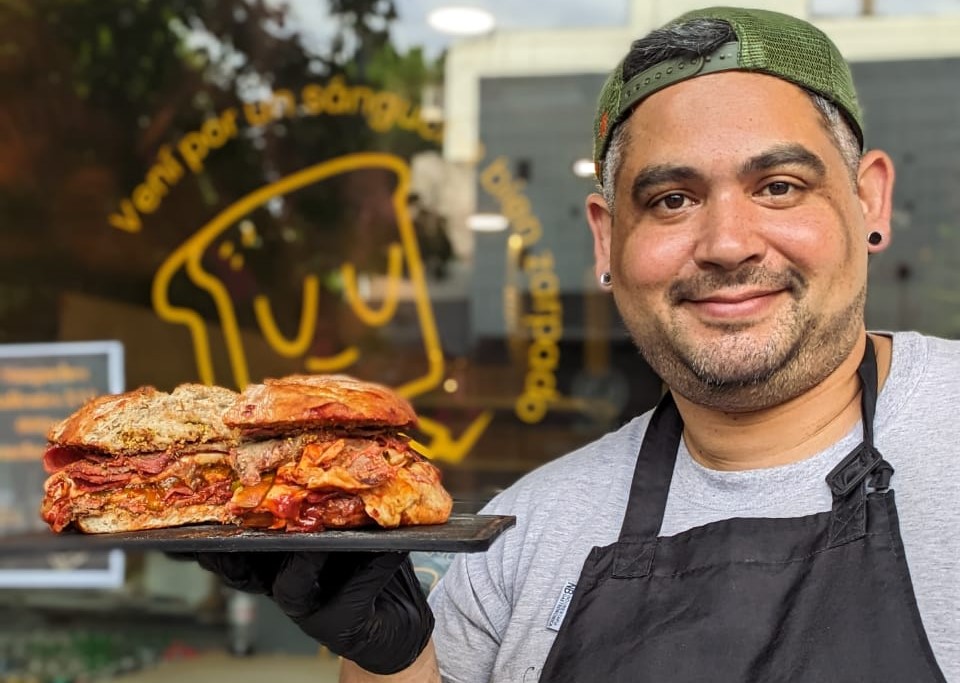
Luis “El Tuco” López is a man who understands the power of a good sandwich. The first time I visited his small sandwich shop, La Sanguchería 10-25, he welcomed me with open arms. He introduced me to his family and even his dog, Bruno, who lounged lazily by the counter, observing the flow of customers like a silent guardian of the establishment.
Luis arrived in Argentina from Venezuela in 2015, just one month after marrying his wife, Adoración. Back in Venezuela, he was already dedicated to the culinary arts, and his passion for gastronomy continued from his very first day in Buenos Aires. Over the years, he worked in various kitchens, including the historic but sadly closed down Grill Plaza at the Hotel Plaza—the only place in the city that served canard à la presse. But about a year ago, Luis decided it was time to fulfill a lifelong dream: opening his own place. In discussing the idea with his wife, they reached a key conclusion that would define La Sanguchería 10-25: they wanted to sell a product that people universally enjoy, something that could make everyone happy. They decided on sandwiches, but not just any sandwiches—they wanted to create something special. Their choice was deeply rooted in the sandwich culture of Buenos Aires, a city where sandwiches have always held a special place in daily life. Luis worked to honor these traditions while adding his own innovative touch, blending local heritage with global inspiration.
Buenos Aires has a long-standing tradition of sandwiches that transcends generations. One iconic example is the carritos—food carts stationed along the Reserva Ecológica or the avenue near the city airport. These carts serve a variety of grilled or griddled sandwiches, from choripán and burgers to the undisputed favorite: the bondiola sandwich. When it comes to steak sandwiches, the clear reference is La Rambla with its famed sándwich de lomo—a juicy, tenderloin sandwich that has become legendary in the city. Meanwhile, other establishments have grown into institutions for sandwich lovers, such as El Buen Libro, Bar 71, and Café Paulin. Then there’s the beloved sándwich de miga, Buenos Aires’ answer to the crustless sandwiches found in English (tea sandwiches) and Japanese (wankapu) cuisine. They’re widely available in bakeries across the city, my personal favorites are Dos Escudos, La Piedad and Caren.
Luis’s sandwiches are special for several reasons. First, he uses top-quality ingredients, with an emphasis on homemade components. You can taste the difference in the bread, sauces, and fillings—everything is carefully prepared to ensure freshness and flavor. Second, his combinations are the product of his own creativity. While some flavor pairings might feel unfamiliar at first, there’s always a touch of something local, grounding each sandwich in a way that feels both innovative and comforting.
One of my personal favorites is the Roast Beef y Pastrami. It brings together two iconic deli meats, reminiscent of the famous Corned Beef and Pastrami sandwich from Katz’s Delicatessen in New York. But Luis makes it uniquely his own by incorporating roast beef, a distinctly local touch that ties it back to Argentine traditions. The result is a sandwich that feels international but tastes like home. Another standout is the Bondiola Picantona. While bondiola is a classic ingredient served by the city’s food carts, Luis gives it a surprising twist. The flavors lean more toward an Asian profile, with the addition of green apple, spicy mayonnaise, and crunchy carrot, creating a perfect harmony of sweet, spicy, and savory. Whether you’re craving the boldness of pastrami or the reinvention of bondiola, there’s something about Luis’s work that always hits the mark.
Lucas Abal (35)
Lawyer and Curious Eater
lucasabal@gmail.com
 sedcontra.com.ar